Product
What is RuleTrace™?
RuleTrace™ is the documentation that ships with every review. It shows the calculation, the rule, and the source regulation behind each line, so a reduction is defensible, not just a number.
How does BillSentry make its bill review pricing defensible?
Every BillSentry pricing decision can be supported by RuleTrace™, which shows how the allowance was calculated, the reimbursement logic that was applied, and the regulatory source supporting the decision.
The BillSentry API returns line-level allowances and reason codes along with a unique RuleTrace™ link, allowing claims professionals, providers and auditors to independently review how and why a bill was priced.
Can I try BillSentry without an integration?
Yes. Use it in the browser with a free trial, or request a sandbox if you are wiring it into a product. The Analyzer and the public API return the same result.
Who is BillSentry for?
BillSentry is built for payers and TPAs that need defensible payment accuracy, RCM and medical billing teams that need to validate reimbursement and identify missed revenue, providers that need to understand and validate reimbursement, and technology partners that need workers’ compensation pricing and RuleTrace™ inside their own products.
Payment Integrity & RCM
What is workers’ compensation payment integrity?
Payment integrity is the practice of validating a medical bill against jurisdiction-specific fee schedules, coding rules, and reimbursement methodologies before payment is issued, so the amount paid is the amount actually owed. In workers’ compensation, that means applying the correct state (or OWCP) rules for the date of service, not a generic price lookup.
What’s the difference between RCM and payment integrity?
Revenue Cycle Management (RCM) is provider-side technology focused on making sure services are coded and billed correctly to capture the reimbursement a provider is owed. Payment integrity is the payer-side counterpart: independently validating that the billed reimbursement is actually correct before paying it. Both should arrive at the same answer, the correct reimbursement, from opposite sides of the transaction.
Does BillSentry replace our existing RCM or claims platform?
No. BillSentry does not replace your existing RCM or claims platform. It adds workers’ compensation reimbursement intelligence to the systems and workflows you already use, either through Bill Analyzer or API.
How is pre-payment integrity different from post-payment recovery?
Post-payment programs identify errors after a bill has already been paid, which usually means investigation, provider outreach, and recovery efforts to get money back. BillSentry validates reimbursement before payment is issued, so pricing errors are caught up front instead of chased down afterward.
Integration & Technical
Can BillSentry integrate with our existing bill review or claims platform?
Yes. BillSentry is API-first and can provide workers’ compensation pricing and payment integrity infrastructure underneath your existing platform.
Your current system can continue managing claims, bills, workflow and payments while BillSentry provides the underlying reimbursement intelligence, including allowances, reason codes and RuleTrace™.
This allows organizations to add workers’ compensation payment integrity without replacing their existing platform.
Do we have to use the BillSentry web application?
No. BillSentry can be used entirely through API. The web application is available for organizations that want a browser-based bill review workflow, but technology partners, carriers and TPAs can integrate BillSentry directly into their existing systems.
What data formats does the API accept?
JSON in, JSON out. X12 837, CMS-1500, and UB-04 data is mapped to that JSON during integration. The request and response shapes are in the API reference.
Can we send both professional and facility bills?
Yes. Professional, facility, pharmacy, DME, and other workers’ compensation bill types are supported.
Do you support real-time and batch processing?
Yes. Typical response time is 250ms; some bills return in about 50ms. Real-time is the default. Batch is supported. Webhooks are usually unnecessary at that speed.
How do you handle OCR for scanned or PDF bills?
BillSentry prices structured bill data. OCR for scanned or PDF bills is not included today.
What authentication and security protocols are used?
API access uses OAuth 2.0 with short-lived JWT access tokens. TLS 1.2 or higher is required. Access is logged for audit; PHI is not logged, only transaction-level data.
Pricing Logic & Accuracy
Which state fee schedules do you support?
All 50 states + OWCP. Fee schedules are updated as soon as they are published. OWCP is fully supported.
Do you support auto medical bill review?
Yes for New York auto. Workers’ compensation is supported in all 50 states plus OWCP. Auto medical bill review outside New York is not supported.
Do you store the bills we send you?
If you use the API only to price bills, we process the request and return JSON. We do not store the bill. Aggregated, non-PHI data may be kept for analytics.
If you use Recon, we store the bills so we can calculate deltas between versions.
Do you handle UCR where fee schedules don’t apply?
Yes. BillSentry supports reimbursement methodologies used in states without a traditional workers’ compensation fee schedule, applying the appropriate jurisdiction-specific pricing rules and methodology for the bill.
Do you support Medispan or Redbook for drug pricing?
Drug pricing uses Medicare NADAC. Medispan is applied when needed.
Do you support PPO or custom network discounts?
Yes, if you send a PPO, negotiated, or adjuster value, we include it in the calculation. We do not send bills out to a PPO vendor to reprice and return.
Do you apply NCCI, MUEs, or global surgery rules?
We follow the state. If the state has adopted NCCI or MUE, we apply it, including NCCI code-pair bundling. Surgery follow-up days are applied to office visits when the state requires it.
Can we override fee schedule rates or rules?
Yes. You can pass external values from a customer, PPO, UR vendor, or similar that override or augment any pricing bucket at the bill or line level. That includes forcing an allowance with no further rules, replacing a value that rules can still adjust, applying a percentage discount, or placing all allowance into a single bucket. Multiple values per bucket are supported, each with its own reason code.
Is every reduction backed by a reason code?
Yes. Every reduction has an internal reason code. Where a state mandates CARC or state-specific codes (California, for example), those are returned as well.
How do recon bills work?
Recons replace a prior bill with a new original, tracked by control number and sequence. Only the latest sequence is used for payments and history, which keeps totals simple and enables delta tracking.
Output & Documentation
What does the API return?
JSON with repriced bill and line data, reason codes, and a RuleTrace™ link (optional QR). That payload is enough to produce an EOR. Every line includes the calculation behind the allowance.
Do you generate an Explanation of Review (EOR)?
Yes. BillSentry returns EOR data as part of review. Outputs can be configured for your format, disclosures, and workflow, including:
- Line-level pricing results
- Your company logo
- Required state disclosures
- Optional QR code to RuleTrace™
Can BillSentry support state reporting requirements?
Yes. Carriers and TPAs typically file the reports. BillSentry supplies the structured data, pricing transparency, and audit trail those workflows need:
- Jurisdiction-specific fee schedules
- Compliant EOR data
- Receipt, review, and processing timelines
- Exportable structured data
- Complete review audit trails
- RuleTrace™ documentation of pricing logic
- WCIO data structures commonly used in reporting
Is the documentation self-service?
Yes. Request and response examples, auth, and endpoints are in the API reference.
HIPAA & Data Security
Are you HIPAA compliant, and do you sign BAAs?
Yes. The platform is built to meet HIPAA administrative, physical, and technical safeguards. We execute BAAs with covered entities and business associates handling PHI.
How is PHI stored, transmitted, and logged?
PHI is encrypted in transit (TLS 1.2 or higher) and at rest (AES-256). We log transaction metadata (timestamps, request IDs), not PHI. Unless you use Recon, we store aggregated data only, not the bill, and not PHI.
Where is PHI stored, and who can access it?
In secure, HIPAA-compliant AWS regions in the United States, inside SOC 2 / ISO 27001 certified data centers. Internal access is role-based, least-privilege, and MFA-protected. Employees complete HIPAA and privacy training annually.
How do you handle breaches, retention, and de-identification?
We follow HIPAA breach-notification rules and can notify customers within required timeframes. PHI is retained only as required by law or contract, then securely deleted. We can strip or mask identifiers for HIPAA-compliant analytics or test data. We run annual HIPAA risk assessments and periodic penetration tests.
For a full overview, .
Edge Cases
How do you handle unlisted codes or unknown modifiers?
State-specific. We follow that jurisdiction’s requirements.
Do you support DRG-based hospital reimbursement?
Yes. Facility and professional bills are supported in all 50 states, including DRG-based hospital reimbursement where the state uses it.
What if multiple jurisdictions apply to one claim?
Allowance follows state rules on claim location and provider location. For states such as Delaware that require the lesser of in-state vs out-of-state, we compare both totals.
Can the API flag questionable or duplicate charges?
Yes. We flag lines disallowed for missing documentation or prior authorization, and we disallow duplicate lines.
Do you support duration limits, frequency caps, or pre-auth?
Pre-auth is supported. Duration and frequency limits follow state guidelines. There is no stand-alone utilization-review product for customer-defined limits.
Audit, Reporting & Analytics
Does BillSentry provide reporting and analytics?
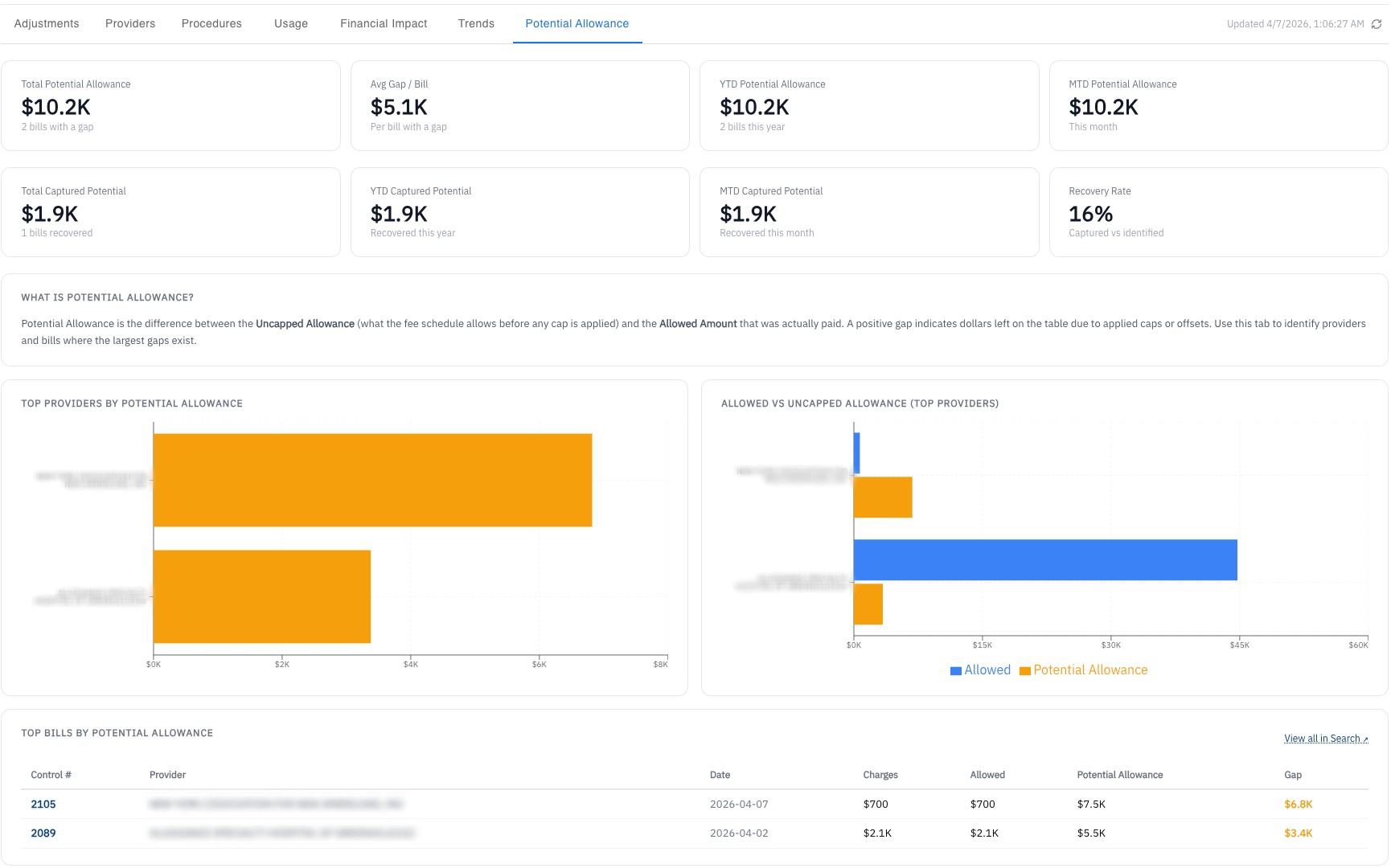
Yes. BillSentry Insights provides reporting and analytics for both payers and providers.
Payer Insights helps organizations understand medical spend, savings, pricing activity and bill review performance.
Provider Insights provides visibility into reimbursement, reductions, payment patterns and potential underpayments.
Insights turns individual bill review decisions into a broader view of reimbursement and payment performance.
Can we obtain logs of review requests and results?
Yes. Detailed logs of how each bill was priced are standard.
Can you track historical pricing or rule changes?
Yes, within the history we have for that source. Medicare goes back almost 25 years; Pennsylvania about one year. When rules change, old rules are termed and new ones take effect on the correct date. Fee schedule data is stored with an effective–term range.
Pricing & Licensing
How is the API priced?
By organization and volume. See pricing or .
Do you offer a sandbox or free trial?
Yes. Start a free trial in the browser, or for API access.
What volume can the API handle, and are there rate limits?
There are no technical rate limits for normal use. We may throttle to stop unauthorized access. The API is multi-threaded and load-balanced.